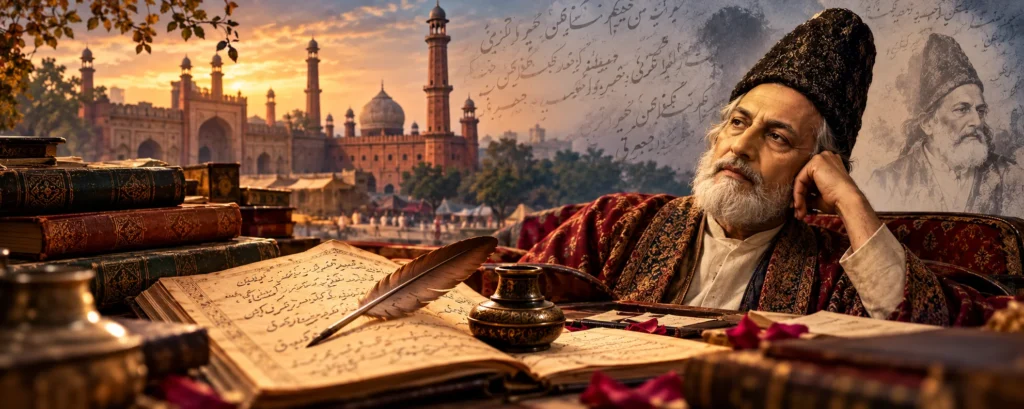

Some poets are remembered. Ghalib is quoted. More than a century and a half after his death, his lines still fall out of ordinary conversation in Delhi, Lahore, Karachi and Lucknow, usually at the exact moment when plain speech runs out. A man loses an argument and reaches for Ghalib. A woman mourns someone and finds that a couplet written in the 1840s says it better than anything she could manage herself.
That is the strange achievement of Mirza Ghalib poetry. It was written for a vanished court, in a Persianised Urdu that even his own readers found difficult, and yet it has outlived almost everything around it. Understanding Ghalib means understanding a specific moment in the history of Urdu shayari, when a classical tradition reached its peak and its world collapsed at the same time.
This guide covers his life, his style, his letters, and ten of his most famous couplets explained line by line.
Who Was Mirza Ghalib?
Mirza Asadullah Baig Khan, known by his pen names Ghalib and, earlier, Asad, was born in Agra in 1797 and died in Delhi in 1869. He wrote in both Persian and Urdu, considered his Persian work the greater achievement, and is remembered chiefly for the Urdu one. Posterity rarely agrees with poets about their own careers.
He descended from a family of Turkish military origin that had come to India in search of service and patronage. His father died when Ghalib was around five, and the uncle who raised him died a few years later. What was left was a small, unreliable pension and a long adult life spent arguing about it with the colonial administration.
He was married at thirteen to Umrao Begum and moved to Delhi, where he lived the rest of his life. None of his children survived infancy. He drank, gambled, borrowed money constantly, and wrote some of the most intelligent poetry in any Indian language. The gap between the disorder of the life and the precision of the verse is part of what makes him so endlessly interesting.
Ghalib was not modest. He knew his own worth and said so, frequently. But the arrogance in his letters sits beside an unusual honesty about failure, poverty and grief, and it is that combination, pride tangled with vulnerability, that gives his poetry its particular voice.
Early Life in Agra and the Move to Delhi
Agra in the late eighteenth century was already a city in decline, a former imperial capital living on memory. Ghalib’s childhood there was comfortable enough in material terms but marked early by loss. The deaths of his father and uncle left him dependent on a pension negotiated through other people, a dependency he never escaped and never stopped resenting.
His education was informal but serious. He learned Persian, Arabic and the classical sciences of the day, and was influenced by a visiting Iranian scholar, Abdus Samad, whose instruction in Persian shaped his lifelong conviction that Persian was the real language of poetry. He was composing verse by his early teens. The famous early ghazals, written before he was twenty, are so densely metaphysical that his contemporaries complained they were unreadable.
The move to Delhi placed him at the centre of the Urdu literary world, but also in direct competition with Ibrahim Zauq, the poet laureate of the Mughal court and tutor to Bahadur Shah Zafar. Their rivalry is the stuff of legend and half the anecdotes are probably invented. What is certain is that Ghalib spent decades on the edge of court recognition, receiving it properly only late in life, when he was finally appointed to write the royal history and given the title Najm ud Daula.
Money was a constant anxiety. He pursued his pension claim all the way to Calcutta, a journey of several years, and lost. He borrowed from friends and publishers. He was once briefly jailed for gambling. None of this fits comfortably with the image of a court poet, and Ghalib never tried to make it fit.
Ghalib and the Fall of the Mughal Empire
Ghalib lived through 1857, and this matters more than any biographical detail.
The uprising and its suppression destroyed the Delhi he knew. British reprisals emptied the city. Friends were executed or exiled. The Mughal emperor, his patron, was tried and deported to Rangoon. Mosques were occupied, libraries scattered, whole neighbourhoods demolished. Ghalib remained in his house in Ballimaran through the siege, largely confined, writing.
The result was Dastanbuy, a Persian diary of those months, careful and politically cautious, since he had every reason to expect it would be read by the authorities. But the private letters from the same period are devastating. He writes of walking through streets where he no longer recognises anything, of the deaths of friends, of a city that exists now only in the past tense.
This is the context for the vein of grief that runs through his later work. The sorrow in Ghalib is rarely only personal. When he writes about ruin, he has seen ruin. Readers who come to Urdu poetry through heart broken poetry in Urdu often find that Ghalib’s version of loss is wider and colder than the romantic kind: it includes the loss of a civilisation, a language’s audience, and a way of living that was not coming back.
He survived another twelve years after the rebellion, pensionless for long stretches, writing letters to friends scattered across north India. He died in February 1869 and is buried in Nizamuddin, Delhi.
What Makes Ghalib’s Poetry Different
Hundreds of poets wrote ghazals in nineteenth century India. Only a handful are still read. The question of what separates Ghalib from his contemporaries has occupied critics for a hundred and fifty years, and a few answers come up repeatedly.
He thinks on the page. Most ghazal poetry of the period works through established emotional positions: the lover suffers, the beloved is cruel, the rival is favoured. Ghalib uses the same furniture but keeps asking awkward questions about it. Why desire at all? What is the self that is doing the desiring? His couplets frequently end not in a sigh but in a paradox.
He compresses ruthlessly. The sher, the two-line unit of the ghazal, has to be complete in itself. Ghalib pushed this to its limit, packing an argument, an image and a reversal into roughly twenty words. If you enjoy the density of two-line Urdu poetry, Ghalib is where the form is at its most concentrated.
He is funny. This gets lost in translation and in reverent recitation. Ghalib is often wry, sometimes self-mocking, occasionally close to blasphemous in a way that is clearly meant to amuse. The couplet about paradise being a pleasant idea for keeping the heart content is a joke, and a serious one.
He refuses easy consolation. Religious, romantic and philosophical comfort are all available in the tradition he inherited. He examines each and mostly declines. What remains is a kind of clear-eyed endurance.
His difficulty is deliberate. Early critics attacked him for obscurity, and he later simplified somewhat, editing his own divan down severely. But the difficulty is not decoration. The thought is genuinely complicated, and the language is doing exactly as much work as the idea requires.
10 Famous Ghalib Couplets with Meaning
What follows are ten of the best known Ghalib couplets, each with the Urdu text, a transliteration, a working translation, and an explanation of what the sher is actually doing. Translations here aim at sense rather than metre. No English version of Ghalib has ever been fully satisfactory, and anyone who tells you otherwise is selling something.
1.
ہزاروں خواہشیں ایسی کہ ہر خواہش پہ دم نکلے
بہت نکلے مرے ارمان لیکن پھر بھی کم نکلے
Hazaaron khwahishen aisi ke har khwahish pe dam nikle
Bahut nikle mere armaan lekin phir bhi kam nikle
Translation: A thousand desires, each one enough to kill me. Many of my longings were fulfilled, and still, far too few.
This is probably the single most quoted couplet in Urdu, and it is almost always quoted wrongly, as a complaint about unfulfilled dreams. Look closer. The speaker admits that many desires were in fact satisfied. The problem is not deprivation, it is the arithmetic of wanting: desire regenerates faster than it can be met. The second line contains a quiet joke at human nature’s expense, and a genuinely unsettling observation about why satisfaction never arrives.
2.
دل ہی تو ہے نہ سنگ و خشت درد سے بھر نہ آئے کیوں
روئیں گے ہم ہزار بار کوئی ہمیں ستائے کیوں
Dil hi to hai na sang o khisht dard se bhar na aaye kyun
Royenge hum hazaar baar koi hamein sataye kyun
Translation: It is only a heart, not stone or brick. Why should it not fill with pain? I will weep a thousand times. Why should anyone object?
A defence of feeling, written with real heat. The couplet answers an unspoken accusation: that grief is weakness, that a man should hold himself together. Ghalib’s reply is almost impatient. The heart is made of soft material; expecting it to behave like masonry is simply a category error. The second line then shifts from justification to defiance. He is not asking permission.
3.
ہم کو معلوم ہے جنت کی حقیقت لیکن
دل کے خوش رکھنے کو غالبؔ یہ خیال اچھا ہے
Hum ko maloom hai jannat ki haqeeqat lekin
Dil ke khush rakhne ko Ghalib ye khayal achha hai
Translation: I know perfectly well what paradise really is, Ghalib, but as a way of keeping the heart cheerful, it is a pleasant enough idea.
The most daring couplet he wrote, and the most carefully constructed. Notice that he never states what the reality of paradise is. The claim to knowledge is made and then withheld, which leaves the reader to supply the scepticism themselves. It is sceptical without being quite deniable, which in nineteenth century Delhi was the only way such a thought could be published at all. The tone is companionable rather than angry, which makes it sharper.
4.
بس کہ دشوار ہے ہر کام کا آساں ہونا
آدمی کو بھی میسر نہیں انساں ہونا
Bas ke dushwaar hai har kaam ka aasaan hona
Aadmi ko bhi mayassar nahin insaan hona
Translation: Since it is hard for anything to be easy, even a man finds it beyond him to become fully human.
The whole couplet turns on the distinction between aadmi and insaan, two words that both translate as man but carry different weight. Aadmi is the biological fact. Insaan is the moral achievement. Ghalib’s point is that the second does not follow automatically from the first, and that most people never manage the crossing. The first line arrives as a dry general principle, almost a shrug, and then the second line applies it somewhere far more uncomfortable.
5.
عشق پر زور نہیں ہے یہ وہ آتش غالبؔ
کہ لگائے نہ لگے اور بجھائے نہ بنے
Ishq par zor nahin hai ye wo aatish Ghalib
Ke lagaaye na lage aur bujhaaye na bane
Translation: Love answers to no one. It is the kind of fire you cannot light at will, and cannot put out once it catches.
A precise description of how desire actually behaves, stripped of every flattering illusion about choice. The symmetry of the second line does the work: the same helplessness at both ends, in the beginning and in the attempt to end it. Anyone reading romantic poetry in Urdu encounters this theme constantly, but few poets state it this coldly. There is no celebration here, only diagnosis.
6.
یہ نہ تھی ہماری قسمت کہ وصال یار ہوتا
اگر اور جیتے رہتے یہی انتظار ہوتا
Ye na thi hamaari qismat ke visaal e yaar hota
Agar aur jeete rehte yahi intezaar hota
Translation: Union with the beloved was never written into my fate. Had I lived longer, I would only have waited longer.
The second line is one of the great reversals in Urdu poetry. It takes the standard lament, I died before I could meet her, and removes the consolation hidden inside it. More time would not have helped. Waiting was not an obstacle on the way to the meeting, it was the whole of the relationship. The couplet converts a specific misfortune into a permanent condition, and does it in eleven words.
7.
ہوئی مدت کہ غالبؔ مر گیا پر یاد آتا ہے
وہ ہر اک بات پر کہنا کہ یوں ہوتا تو کیا ہوتا
Hui muddat ke Ghalib mar gaya par yaad aata hai
Wo har ik baat par kehna ke yun hota to kya hota
Translation: Ghalib has been dead a long while now, yet one still remembers how he said of everything: and what if it had gone otherwise?
He writes his own obituary and makes it a joke about his own temperament. The sher imagines a world continuing after his death in which the thing people miss is not his poetry or his person but a verbal habit, his endless speculative what if. And of course the habit he describes is exactly the engine of his poetry: the refusal to accept that what happened was the only thing that could have happened. Self-elegy and self-portrait in two lines.
8.
رگوں میں دوڑتے پھرنے کے ہم نہیں قائل
جب آنکھ ہی سے نہ ٹپکا تو پھر لہو کیا ہے
Ragon mein daudte phirne ke hum nahin qaayil
Jab aankh hi se na tapka to phir lahu kya hai
Translation: Blood running about inside the veins impresses me not at all. If it never spilled from the eye, what sort of blood was it?
A statement of poetic principle disguised as a physiological observation. Feeling that stays inside, unexpressed and invisible, does not count. The image of weeping blood is conventional in the ghazal tradition, but Ghalib inverts it into a test: the ordinary circulation of blood is dismissed as mere biology, and only the overflow has any value. The same logic applies to grief, and to writing.
9.
موت کا ایک دن معین ہے
نیند کیوں رات بھر نہیں آتی
Maut ka ek din muayyan hai
Neend kyun raat bhar nahin aati
Translation: The day of death is already fixed. So why does sleep refuse to come all night?
The shortest and plainest couplet in this selection, and one of the most unnerving. Two unrelated facts are placed side by side, with the logical connection left out. If fate is settled, anxiety is pointless, and yet here is the body, awake at three in the morning, unconvinced by the theology. The couplet does not resolve the contradiction. It simply reports that human beings are not persuaded by their own beliefs, which is a more honest thing to say than any resolution would be.
10.
قرض کی پیتے تھے مے لیکن سمجھتے تھے کہ ہاں
رنگ لاوے گی ہماری فاقہ مستی ایک دن
Qarz ki peete the mai lekin samajhte the ke haan
Rang laavegi hamaari faaqa masti ek din
Translation: We drank wine bought on credit, but we always knew our cheerful starvation would show its colours one day.
Ghalib on his own finances, with no self-pity whatsoever. Faaqa masti is an untranslatable compound, something like the intoxication of going hungry, the high spirits of the broke. The couplet is funny and then, on the second reading, not funny at all, because rang laana means both to bear fruit and to show its true effects. He is predicting either vindication or ruin, and deliberately not saying which.
Ghalib’s Letters: The Other Half of His Genius
Many critics argue that Ghalib’s prose is as important as his verse, and in one specific sense it is more important: it changed what Urdu prose could be.
Before him, letter writing in Urdu was heavily formal, weighed down by honorifics and ornamental Persian convention. Ghalib dropped nearly all of it. He wrote to friends as he spoke to them, abruptly, affectionately, sometimes rudely. He opens with a complaint and ends mid thought. He addresses correspondents by nicknames. He mixes gossip, requests for money, literary criticism and grief in the same paragraph.
The collections known as Urdu e Mualla and Ud e Hindi preserve hundreds of these letters, and they are the closest thing we have to hearing him talk. They also form the best eyewitness record of Delhi after 1857 written by someone who stayed.
Two things make them valuable beyond their historical use. First, they explain the poetry. Ghalib discusses his own work, his revisions, his opinion of rivals, his irritation with readers who wanted everything simplified. Second, they established a model of conversational Urdu prose that later writers built on directly. The ease of modern Urdu non-fiction owes him a debt that is rarely paid in full.
He was lonely in those final years. Most of the letters are, underneath the jokes, an attempt to keep a scattered circle of friends in the room with him a little longer.
Why Ghalib Still Dominates Urdu Poetry Today
Ask a reader in Karachi or Delhi to name an Urdu poet and the answer is predictable. Ghalib’s dominance is so complete that it has become invisible, like weather.
Part of the reason is quotability. His couplets are self-contained, memorable, and applicable to an enormous range of situations. They survive being detached from context, which is exactly what oral transmission requires, and now what social media requires too.
Part of it is intellectual range. A reader at twenty finds the love poetry. A reader at forty finds the metaphysics and the scepticism. A reader who has lost someone finds the grief. The work keeps opening into new rooms, which is not true of most poets who are merely elegant.
Part of it is historical position. Ghalib stands at the exact hinge between the classical Mughal world and the colonial modern one, and he is articulate about both. Anyone trying to understand what was lost in 1857 ends up reading him.
And part of it is temperament. He is proud, broke, sceptical, witty, grieving and unapologetic, which is a recognisably modern combination of qualities to encounter in a man born in 1797. He does not sound like a monument. He sounds like someone you could argue with.
Film, qawwali, ghazal recordings by Mehdi Hassan and Jagjit Singh, television serials, and now endless social media posts have carried him into households that own no poetry books at all. The couplets circulate, often misquoted, sometimes misattributed, always alive.
That is the only kind of immortality a poet actually gets.
FAQs
Who was Mirza Ghalib in simple terms?
Mirza Asadullah Baig Khan, known as Ghalib, was a nineteenth century poet who wrote in Urdu and Persian, lived most of his life in Delhi, and is widely regarded as the greatest poet in the Urdu language. He lived from 1797 to 1869 and witnessed the destruction of Mughal Delhi in 1857.
What is Ghalib’s most famous couplet?
The most frequently quoted is the opening sher of the ghazal beginning “Hazaaron khwahishen aisi”, about a thousand desires each strong enough to kill. The couplet about paradise being a pleasant idea for keeping the heart content runs a close second.
Why is Ghalib’s poetry considered difficult?
His early work uses dense Persian vocabulary and compressed metaphysical arguments, which even his contemporaries found obscure. He simplified his style considerably in later years and edited his own Urdu divan down severely, which is why the collection we read today is far more accessible than his earliest manuscripts.
Did Ghalib write in Urdu or Persian?
Both, and he produced far more Persian than Urdu. He considered the Persian work his real achievement and the Urdu almost secondary. Readers have decided otherwise, and his Urdu divan is now the more widely read of the two.
What is the difference between a sher and a ghazal?
A sher is a single couplet, complete in meaning on its own. A ghazal is a sequence of such couplets sharing a common metre and rhyme scheme, where each sher can stand independently. This is why Ghalib’s couplets are so easily quoted in isolation.
Where is Mirza Ghalib buried?
His tomb is in Nizamuddin, Delhi, close to the shrine of Nizamuddin Auliya. His former residence in Ballimaran, in Old Delhi, has been preserved as a museum.
Are Ghalib’s letters worth reading?
Yes, particularly for anyone interested in the poetry or in the history of 1857. They are informal, funny, and often painful, and they effectively created the conversational register of modern Urdu prose.